
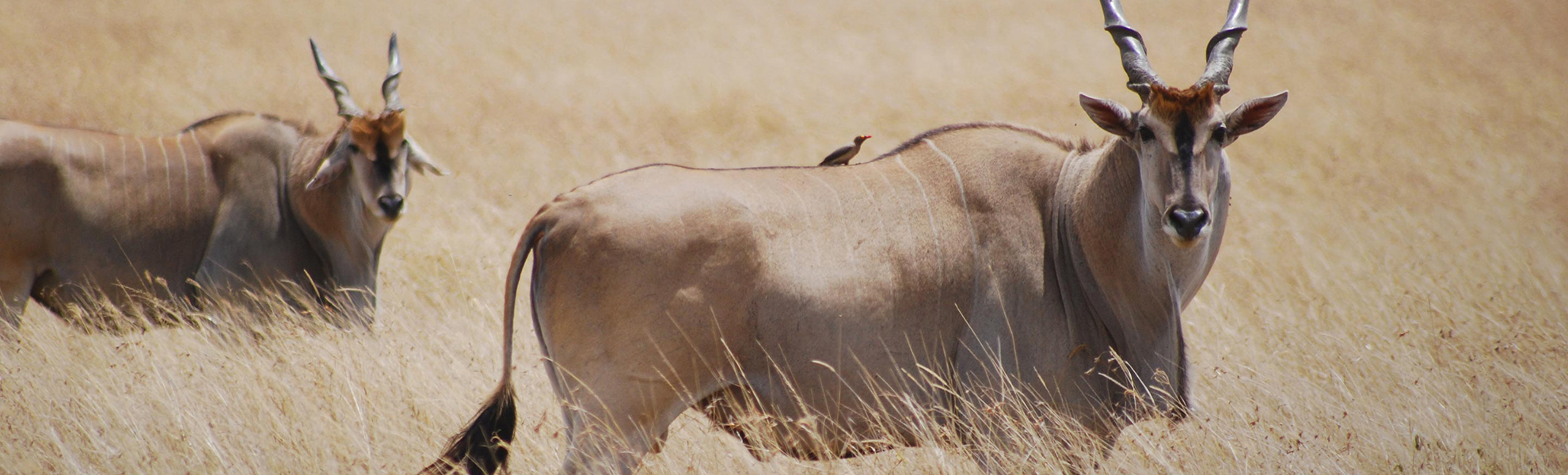
Adult male Cape Elands typically weigh around 700–900 kg (1,540–1,980 lbs), while females average 450–600 kg (990–1,320 lbs). Their shoulder height commonly reaches 150–180 cm (59–71 in). The species has a life expectancy of approximately 15–20 years in the wild.
Identification
The Cape Eland is a large, robust antelope characterised by a fawn to greyish-tan coat, often marked with faint vertical stripes along the flanks. A dewlap hangs prominently from the throat, and both males and females possess straight, spiralled horns that angle upward. Mature males tend to darken in colour and may develop a tuft of dark hair on the forehead.
Habits
Cape Elands inhabit savannahs, open grasslands, and lightly wooded areas, where they browse and graze on a variety of vegetation, including leaves, grasses, seeds, and fruits. Although not water-dependent, they will drink when water is available and can survive long periods by obtaining moisture from their food.
They are generally social animals, forming mixed herds that may include females, young, and subadult males, while older bulls may form bachelor groups or live semi-solitary lives. Movements are often dictated by food availability, and herds may travel considerable distances. Despite their size, they are surprisingly agile and capable of jumping impressive heights when startled.
Breeding
The gestation period of the Cape Eland is roughly 9 months, after which a single calf (occasionally twins) is born. Newborns spend their early days hidden in dense cover, with the mother returning frequently to nurse. Calves join the herd after about 3–4 weeks, remaining close to the mother as they grow and develop.